You’ve Caught It Early. Here’s What to Do Next.
There’s a meaningful difference between a foundation problem that’s been ignored for years and one that’s been caught while it’s still manageable. Homeowners who reach out to Oklahoma Foundation Solutions at the Corrective Stage consistently have better outcomes, simpler repairs, and lower costs than those who wait until the damage becomes severe. The benefits of scheduling foundation repair sooner rather than later are significant.
If your concrete slab foundation is showing early signs of movement, then you’re in that first category. That matters more than most people realize.
The Corrective Stage doesn’t mean your home is in crisis. It means the foundation has begun to shift in ways that are visible and measurable, and that addressing it now will protect both the structure and the investment you’ve made in your home.
What Corrective Stage Concrete Slab Problems Look Like
At this stage, the signs of foundation movement are present but haven’t yet escalated to the point of severe structural concern. As outlined in our KFOR guide to understanding and identifying foundation-related issues, common Corrective Stage indicators on a concrete slab foundation include:
- Moderate cracks in the concrete slab: visible cracks that have moved beyond hairline territory and warrant professional evaluation
- Moderate unevenness or sloping in floor areas: subtle enough to go unnoticed at first, but consistent enough to confirm that some settling has occurred
- Sheetrock cracks forming above doorways or along interior walls: a reliable indicator of differential movement in the slab below
- Moderate misalignment of door frames: doors that stick, swing open on their own, or no longer latch properly without force
- Moderate gaps between baseboards and the slab: separation that suggests the slab has shifted relative to the walls sitting on top of it
If several of these signs are present simultaneously, the slab has likely experienced measurable movement, and a professional evaluation is the right next step.
What Causes Concrete Slab Movement in Oklahoma
Oklahoma’s expansive clay soil is the primary culprit behind the majority of residential slab issues in our state. Clay soil absorbs moisture and swells during wet periods, then contracts sharply as conditions dry out. This continuous cycle of expansion and contraction applies stress to the slab from below, and over time that stress accumulates into the kind of visible movement that defines the Corrective Stage.
Beyond soil behavior, other contributing factors include plumbing leaks beneath the slab, poor soil compaction at the time of original construction, and drainage issues. In many cases, more than one of these factors is at play simultaneously, which is part of why a thorough, professional evaluation matters so much at this stage.
The good news is that Corrective Stage slab issues are among the most manageable foundation problems we encounter. Catching the movement at this point keeps the repair options straightforward and the costs significantly lower than they would be at a more advanced stage.
How Corrective Stage Concrete Slab Repair Works
For most Corrective Stage situations involving concrete slab movement, the primary repair method is an engineer-approved process called polyurethane injection. It’s a fast, non-invasive, and cost-effective solution designed specifically for this type of problem. You can learn more about this and related services on our concrete leveling and repair page.
The process works by injecting polyurethane beneath the settled slab, where it expands to fill existing voids and can often gently lift the affected areas. Here’s how it unfolds from start to finish:
- Preparation — The crew prepares the work area to ensure a clean, efficient project with minimal disruption to the home.
- Precision drilling — Small, carefully placed holes are drilled into the slab at the locations where lifting is needed.
- Injection and expansion — Polyurethane foam is injected through the holes, expanding beneath the slab to fill voids and restore support.
- Sealing — The drilled holes are patched, and the surface is ready for use immediately after the work is complete.
The result is a stabilized slab that’s been restored without the disruption, cost, or timeline of more invasive repair methods.
When slab movement has produced visible cracks running across the interior concrete slab, a separate engineer-approved process called floor stitching is often recommended alongside polyurethane injection. Floor stitching involves removing several inches of concrete on each side of the crack, drilling and pinning rebar for reinforcement, and pouring new concrete to restore the floor to a single, unified slab.
In situations where cracks are too severe or widespread for floor stitching to be a viable option, partial or complete interior slab replacement may ultimately be the right path forward to ensure long-term structural stability. These cases are less common at the Corrective Stage, but worth understanding as part of the full picture.
A $50,000 Lesson From Edmond, OK
A few years ago, we evaluated a home in Edmond where a husband and wife had grown increasingly concerned about their concrete slab foundation. After a thorough evaluation, the recommendation was a straightforward repair plan priced at $4,150.
That’s when the wife said something that has stayed with us since: “We appreciate your thorough evaluation, but we’re confused. Another company quoted us over $56,000. What do you recommend we do?”
Rather than simply asking them to take our word for it, we suggested they hire an independent, third-party structural engineer to provide an objective assessment of what the home actually needed. When the engineer’s report came back, it aligned with our findings exactly. The additional $50,000 in work the other company had proposed was completely unnecessary.
The couple moved forward with the repair, and their home remains structurally sound and stable to this day. They told us afterward that our honesty and professionalism gave them exactly the peace of mind they had been looking for throughout the process.
That story reflects something we believe deeply at Oklahoma Foundation Solutions: the right answer isn’t always the most profitable one. As we’ve discussed on KFOR, the free evaluation model in this industry is too often used as a sales tool rather than a genuine service — and the Edmond homeowners experienced exactly that firsthand before finding us. We covered this story in full on KFOR if you’d like to read the complete account. Our job is to give homeowners the truth and the right solution, nothing more and nothing less.
An Important Note About Interior and Exterior Foundation Movement
If you’re noticing Corrective Stage signs inside your home and also seeing things like brick cracks, gaps near windows, or displaced trim on the exterior, that combination isn’t unusual in Oklahoma. In most homes here, the interior concrete slab and the exterior foundation system aren’t structurally tied together, which means they can move independently and at different rates.
That’s precisely why our free evaluation covers both areas. A complete picture of what’s happening inside and outside gives you a full understanding of your home’s structural condition and ensures that any repair plan addresses everything that needs attention.
What to Expect From a Free Evaluation at the Corrective Stage
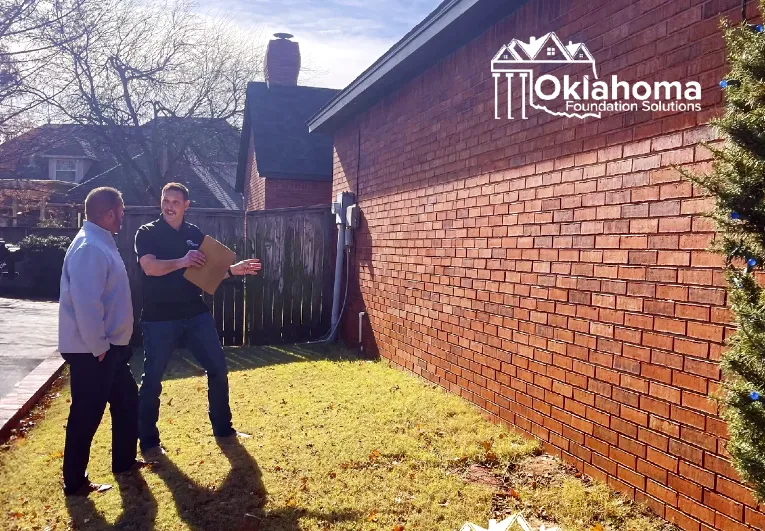
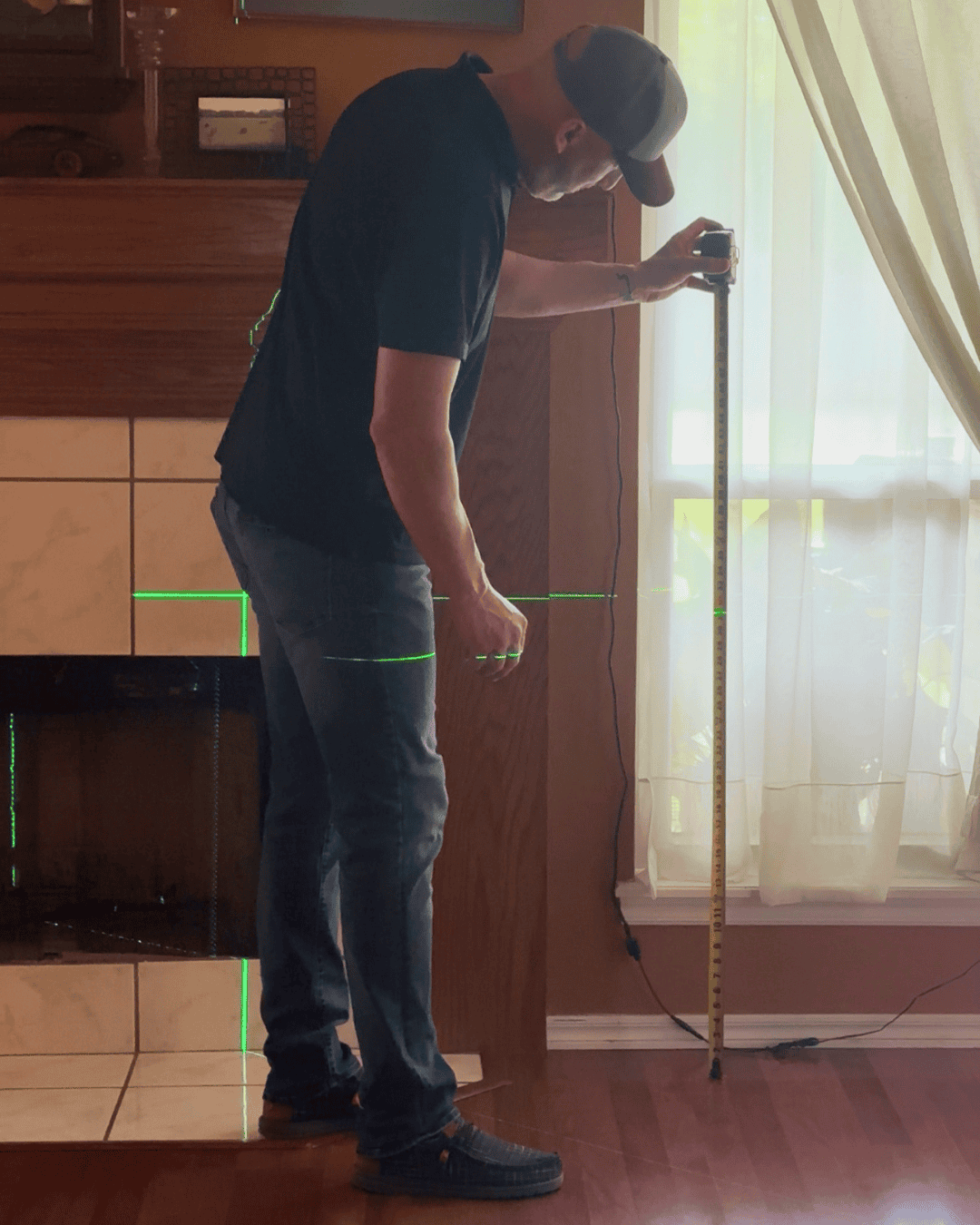
When one of our experts evaluates a Corrective Stage home, the goal is the same as it is at every stage: give the homeowner a clear, honest assessment of what’s happening and what it means for their home. Here’s exactly what to expect when you schedule one: a thorough review of every sign of movement, a plain-language explanation of the findings, and a customized repair plan based on what the home actually needs.
Not sure whether your home is in the Corrective Stage? Start with our OFS Free Foundation Health Check. It’s a quick, two-minute online quiz that helps Oklahoma homeowners identify which stage their foundation may be in before scheduling an on-site evaluation. Once the quiz is completed, you’ll find out where your home likely falls on the OFS Stability Scale. You’ll also receive a free customized video, PDF report, and email tailored to your specific foundation type.
If the OFS Free Foundation Health Check points toward Corrective Stage signs on your concrete slab, the next step is a free, no-obligation in-person evaluation. And if your foundation doesn’t need work? We’ll tell you that too. At OFS, we never sacrifice goodwill for profit.
Schedule your free foundation evaluation today
Frequently Asked Questions
How is the Corrective Stage different from the Preventative Stage for concrete slab foundations? The Preventative Stage involves subtle, early signs of movement that may not yet require repair. These include hairline cracks, very minor gaps, and slight door sticking. The Corrective Stage means movement has progressed to the point where correction and stabilization are likely needed to prevent further damage. The signs are more pronounced, more consistent, and more likely to worsen without intervention.
Is polyurethane injection a permanent solution for concrete slab problems? Yes. Polyurethane injection is an engineer-approved, long-lasting solution for filling voids and lifting settled slab sections.
What happens if concrete slab problems are left unaddressed at the Corrective Stage? Foundation movement rarely stays the same over time. Oklahoma’s clay soil continues to cycle through wet and dry seasons regardless of what’s happening above it, and each cycle adds more cumulative stress to a slab that’s already shifted. Corrective Stage problems that go unaddressed have a consistent tendency to progress toward more severe damage that requires more complex and costly repairs.
Related reading: