When the Signs Are This Clear, Waiting Is the Costliest Option
Most foundation problems start quietly. A hairline crack here, a small gap there; easy to dismiss, easy to monitor. We covered those early signals in our post on exterior foundation warning signs and the Corrective Stage.
Some homeowners, however, reach out to us after the signs have moved well beyond subtle. The cracks are significant. The gaps are wide. The damage is clearly visible. This is what Oklahoma Foundation Solutions calls the Critical Stage, and it calls for a different level of urgency.
The good news is that, even at the Critical Stage, these problems are fixable. We resolve situations like this every week for homeowners across Oklahoma. But the longer critical action is delayed, the window for affordable repair narrows. And that’s the part worth understanding clearly before anything else.
What Critical Stage Exterior Warning Signs Look Like
At the Critical Stage, a home’s exterior is showing major evidence of foundation movement. The evidence goes well beyond hairline cracks or minor shifts. They’re signals that your foundation has been under significant stress, likely for some time.
As detailed in our KFOR guide to understanding and identifying foundation-related issues, warning signs at this stage include:
- Significant cracks in brick and mortar — large, visible cracks that have progressed well beyond hairline splits, often running in stair-step patterns across multiple courses of brick
- Large gaps between brick and windows or wood trim — separation that is now clearly visible and measurable, indicating the structure has shifted substantially around its openings
- Noticeable displacement of the frieze board — the trim between your soffit and exterior walls has shifted visibly, particularly at corners, signaling movement across a broad section of the foundation
- Sheetrock damage along outside walls — interior drywall cracking near exterior walls at the Critical Stage is typically more extensive and may appear in multiple locations simultaneously
If these descriptions match what you’re seeing on and around your home, then this is not a situation to monitor. It’s a situation to address immediately with local experts.
Why Oklahoma Homes Reach the Critical Stage
The cause is the same as it is at every stage of foundation movement: Oklahoma’s expansive clay soil. But at the Critical Stage, that soil has had more time, more seasons, and more moisture cycles to do its work.
Clay soil swells significantly when it absorbs rainfall and contracts sharply during dry periods. Every expansion and contraction cycle applies stress to your foundation. Over time, that cumulative stress produces the kind of visible, structural movement that defines the Critical Stage.
This isn’t a reflection of your home’s construction quality or age. It’s the predictable result of building on Oklahoma soil without intervention, and it’s why early evaluation matters so much. As we’ve seen time and again, the homeowners who act at the Corrective Stage have simpler, less costly repairs than those who reach the Critical Stage.
But reaching the Critical Stage doesn’t mean it’s too late. It means it’s time to act now.
The Danger of Waiting at the Critical Stage
At earlier stages of foundation movement, monitoring is sometimes a reasonable short-term option. At the Critical Stage, it isn’t.
Foundation movement at this level is almost never self-correcting. Oklahoma’s clay soil will keep cycling through wet and dry seasons, and each cycle adds more stress to a foundation that is already under strain. What costs X to repair now can cost multiples of that six months from now.
As we’ve outlined in detail, there are clear financial and structural benefits to scheduling foundation repair sooner rather than later. Those benefits are most pronounced at the Critical Stage, where delays carry the greatest risk of escalating both damage and cost. The most affordable time to address Critical Stage foundation issues is right now.
How Foundation Repair Works at the Critical Stage
The solution for Critical Stage exterior foundation movement is the same engineer-approved system used at the Corrective Stage: the hydraulically-driven steel pier. What differs is the scope of work (the number of piers needed, the areas addressed, the complexity of the stabilization plan. etc.).
As covered in detail in our KFOR feature on why steel piers outperform concrete piers in Oklahoma, this system is specifically engineered for our state’s soil conditions and provides lasting structural stability where concrete piers consistently fail.
Here’s how the installation process works:
- Excavation — Crew members dig with shovels below the footings of the home.
- Bracket placement — A premium steel bracket is positioned underneath the footing, creating a stable anchor point for the pier system.
- Pier installation — A hydraulic ram drives high-quality steel pipe through the bracket until it reaches the point of refusal, or load-bearing strata, capable of supporting the home’s weight.
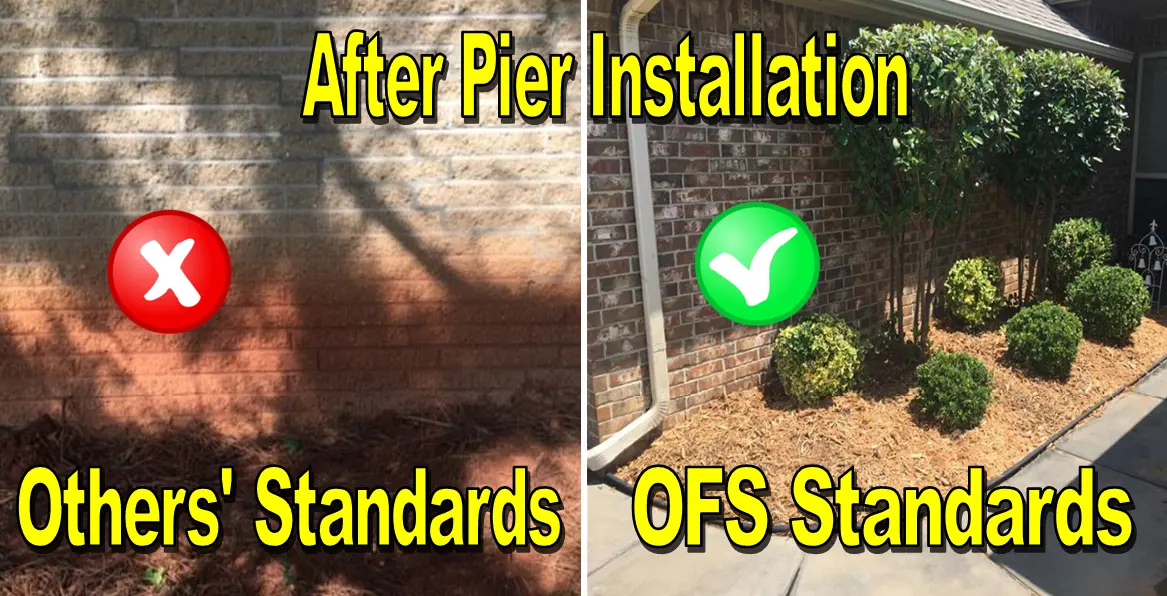
- Welding and backfill — The pipe is welded to the bracket, excavated soil is backfilled and tamped, and the exterior is re-mortared and caulked at each pier location.
Backed by a lifetime transferable warranty, the result transfers the weight of your home away from unstable Oklahoma clay and onto rock solid ground.
A Critical Stage Story From Northwest Oklahoma City
We evaluated a home in northwest Oklahoma City where the foundation movement had progressed well into the Critical Stage. The homeowner, an extremely caring and polite person, was deeply concerned. She loved her home and had watched the exterior signs worsen over time, unsure of who to trust or what the repair process would look like.
During the evaluation, we walked her through exactly what was happening structurally, explained the work that was needed in plain terms, and answered every question she had. She told us afterward that she chose OFS specifically because of our knowledge and our honest, straightforward approach. She said that she didn’t feel pressured, and she felt informed.
When the work was complete, she shared this:
“They were very kind, not pushy, and incredibly professional. Their work was exceptional and reasonably priced. I cannot say enough good things about them. It is unusual in this day and time to find a company with so much honesty and integrity. I can guarantee you will be totally pleased and satisfied.”
That review captures something important about the Critical Stage. Even when the problems are significant and even when a homeowner has been carrying the weight of worry about their home’s future–the right team, carrying out the right plan with skill and integrity, can restore not just a foundation but genuine peace of mind.
What to Expect From a Free Evaluation at the Critical Stage
When our expert evaluates a Critical Stage home, the process is thorough and personalized. We assess every major exterior sign of movement, identify the underlying causes, and provide a complete, customized stabilization plan — not a generic estimate.
We’ll explain what we’re seeing, what it means for your home’s long-term stability, and exactly what scope of work is needed. And if something doesn’t require immediate repair, we’ll tell you that too. At OFS, we never sacrifice goodwill for profit.
We understand that many Oklahoma homeowners have had frustrating experiences with foundation repair companies that turned a “free evaluation” into an unrelenting sales pitch. As we discussed on KFOR, the traditional free evaluation model is broken — and there’s a better way. Our approach starts with education and transparency, not pressure.
Not sure whether your home has reached the Critical Stage? Start with our Free Foundation Health Check. It’s a short, guided video series that helps Oklahoma homeowners identify which stage their foundation may be in before picking up the phone. After completing a quick two-minute online quiz, you’ll find out where your home likely falls on the OFS Stability Scale. You’ll also get a custom video, PDF report, and email tailored to your specific foundation type. It’s quick, it’s free, and it gives you clarity before committing to anything.
If the OFS Free Foundation Health Check points toward Critical Stage signs, don’t wait. The most affordable time to act is always right now.
Schedule your free foundation evaluation with Oklahoma Foundation Solutions today →
Frequently Asked Questions About Foundation Repair in a Critical Stage
What’s the difference between Corrective Stage and Critical Stage foundation problems on the exterior? Corrective Stage signs are early to moderate in nature. These signs include cracks, small gaps, and subtle shifts that often allow more flexibility in timing. Critical Stage signs are major: significant cracking, large gaps, noticeable structural displacement. At the Critical Stage, delays typically increase both damage and repair costs.
Can Critical Stage foundation damage on the exterior be fixed permanently? Yes. Hydraulically-driven steel piers, installed to the point of refusal, transfer the home’s weight onto stable ground and prevent further movement. Oklahoma Foundation Solutions backs this system with a lifetime transferable warranty.
How long does Critical Stage exterior foundation repair take? Every home is different depending on the number of piers needed and the scope of the affected areas. During your free evaluation, we’ll provide a clear timeline along with a full customized repair plan.
Related reading:
- Early Foundation Warning Signs on Your Home’s Exterior: What Oklahoma Homeowners Need to Know
- Benefits of Scheduling Foundation Repair Sooner
- The Truth About Foundation Repair Warranties: What Really Matters
- 5 Questions to Ask a Foundation Repair Company Before You Sign the Warranty
- Understanding and Identifying Foundation-Related Issues for Your Home — KFOR
- Steel Piers or Concrete Piers: Which Is Better for Foundation Repair in Oklahoma? — KFOR
- Stop Falling For The “Free Evaluation” Trap: A New Opportunity For Homeowners — KFOR