Search online for foundation repair and you may run into a familiar parade of warnings: “Your house could be in danger.” “Every day you wait could cost you more.” “That small crack may be the beginning of a major structural failure.” “Look at this picture of a crumbling brick house!” Some concerns are serious, of course, but fear-heavy messaging can make homeowners feel cornered before anyone has even looked at the property.
There is a better reason to look into foundation concerns early: information gives you room to think.
When you understand what is happening while the signs are still limited, you have more time to monitor changes, compare recommendations, plan financially, and decide what fits your home. A professional record of the home’s current condition can make each of those decisions easier.
Why Early Information Is Valuable
A foundation evaluation can document the home’s current condition and give the homeowner a clear point of comparison for the future. Foundation professionals sometimes call this a baseline, but the idea is simple: record what the home looks like now so you can recognize meaningful changes later.
That record may include:
- Photographs of visible cracks, gaps, or displacement
- Notes about sticking doors, uneven framing, or changes in the floor
- Floor elevation measurements
- Locations of interior and exterior symptoms
- Observations about the slab, crawl space, or exterior walls
- A professional opinion about whether the condition appears cosmetic, structural, stable, or likely to progress
If something changes six months or a year later, you are no longer relying on memory. You have documentation showing where the concern started and whether it has actually grown.
Why Tracking Changes Is Especially Helpful in Oklahoma
Oklahoma homes are exposed to soil conditions that can place ongoing pressure on foundations. Expansive clay soil swells when it absorbs water and contracts during dry periods. That repeated movement can affect concrete slabs, crawl spaces, exterior brick, interior walls, and door frames.
Because the soil changes over time, one photograph or brief observation may not tell the whole story. A documented starting point can help separate a stable cosmetic issue from a condition that is becoming more noticeable.
For example, a thin sheetrock crack may remain unchanged for years. A similar-looking crack that continues to widen, returns after patching, or appears alongside other signs deserves more attention. Tracking the condition gives the homeowner useful context.
Early Answers Can Preserve More Repair Choices
The earlier a concern is understood, the more choices a homeowner may have.
In some cases, the recommendation may be to monitor the area and take new photos at regular intervals. Another home may need a limited repair in one section. A more advanced situation may call for stabilization with piers, polyurethane injections, crawl space support, or another service suited to the structure.
Waiting does not automatically create an emergency, and no honest company should pretend that every minor sign will become catastrophic. Still, movement that continues can affect additional areas of the home and make the eventual scope of work more involved.
Getting answers early gives homeowners a chance to respond while the situation is easier to understand and while a greater range of options may still be available.
More Time Makes Financial Planning Easier
Foundation repair can be a significant home expense, and most families prefer time to prepare for it.
An early professional evaluation can help homeowners plan instead of reacting under pressure. If the inspector recommends monitoring, the homeowner may have months or years to watch the condition and prepare for a possible future repair. If limited work is recommended, the homeowner can review payment options and decide when to proceed. If the issue needs prompt attention, the homeowner still benefits from understanding exactly why.
Accurate documentation is valuable here. A vague fear that something may be wrong with the foundation is difficult to plan around. A clear report with identified symptoms, measurements, and recommended next steps is much easier to consider when building a household budget.
Records Can Help During a Future Home Sale
Foundation questions often arise when a property is listed for sale. Buyers may notice cracks, ask about previous repairs, or request additional information after an inspection.
A homeowner with photographs, evaluation records, repair documents, and warranty information is in a stronger position to explain the history of the home. Even when no repair was recommended, a professional record can show that the concern was reviewed and monitored responsibly.
That documentation will not remove every question from a real estate transaction. It can reduce uncertainty for the owner, buyer, real estate professionals, and other parties involved.
How the OFS Free Foundation Health Check Helps Homeowners Start
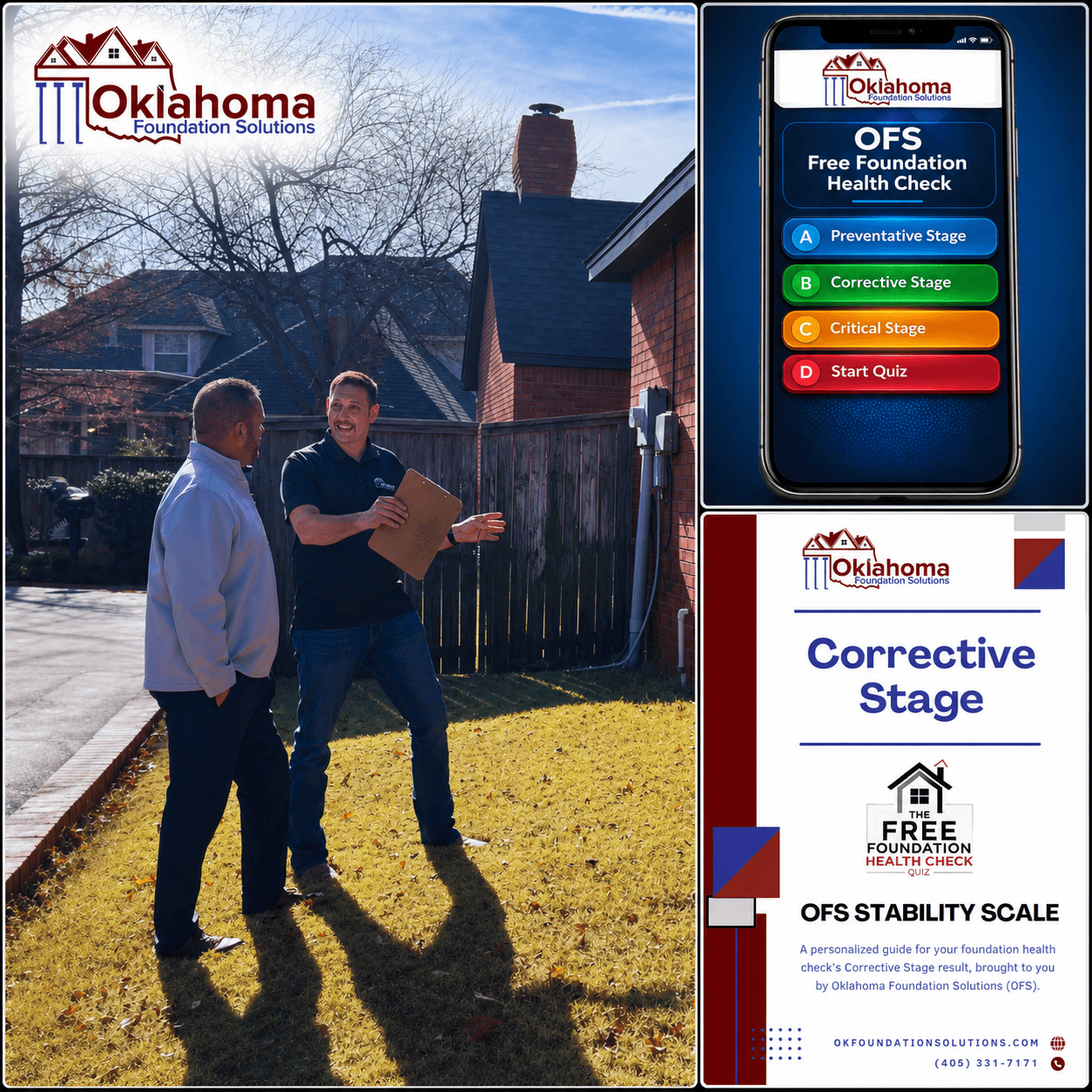
The OFS Free Foundation Health Check helps Oklahoma homeowners organize the signs they are seeing before an on-site evaluation.
The quiz places the home on the OFS Stability Scale as Preventative, Corrective, or Critical. After completion, the homeowner receives a results page, related video content, and a detailed PDF report by email.
That report provides a useful early reference. It explains the stage, identifies common causes and symptoms, outlines possible services, and provides a roadmap for what the homeowner can do next. Because the report is emailed, it can be saved, shared, and reviewed later.
The quiz is an educational screening tool and cannot replace measurements or an inspection of the property. It does help homeowners approach the next step with stronger background knowledge and better questions.
Honest Guidance May Include Monitoring or No Repair
A foundation evaluation should not feel like a countdown to a sales pitch.
At Oklahoma Foundation Solutions, inspectors are trained to explain what they observe and recommend only what the home needs. Sometimes that means a repair plan. Sometimes it means a smaller scope of work. In other cases, the right answer is to monitor the area or complete no work at that time.
The homeowner receives useful information regardless of whether there is anything to purchase.
OFS is certified by the Oklahoma Real Estate Commission to teach courses about home foundations and foundation repair. Education is part of the company’s work with homeowners, real estate professionals, and the broader Oklahoma community.
Trust also has a longer life than any single project. Giving a homeowner an honest answer today creates the kind of relationship that can last for years, whether the homeowner eventually needs repair work, calls with a future question, or recommends OFS to someone else.
Start With Information Instead of Fear
Foundation concerns deserve attention. That attention can begin with a measured, informed look at the home instead of a frightening prediction.
Documenting the condition gives homeowners a way to replace uncertainty with useful information. It helps them recognize real changes, plan around possible repairs, preserve options, and make decisions on their own timeline.
If you have noticed possible warning signs and want a clearer starting point, take the OFS Free Foundation Health Check:
https://okfoundationsolutions.com/freefoundationhealthcheck/
***
Related Reading
Preventative Stage Foundation Warning Signs: A Real OFS Customer Story About Getting Answers Early