Cracked, Settled, or Sunken Concrete? Don’t Panic!
You’re proud of your home. You keep it immaculate, from the gleaming floors to the freshly painted walls. But lately, you’ve noticed a few things that just seem…off. You spot a diagonal crack snaking its way across the wall above the living room doorway. You observe a growing gap between the baseboards and the floor. Maybe you even see some doors that stick or don’t close properly.
You might dismiss these as minor cosmetic issues, but they could be flashing red warning signs of foundation failure. Ignoring them could lead to a cascade of costly repairs down the road.
At Oklahoma Foundation Solutions, we understand that discovering foundation issues in your home can be incredibly stressful. It’s not just about the cracks in the walls or the uneven floors. It’s about the disruption to your life, the worry about your family’s safety, and the potential financial burden. Suddenly, that home kitchen remodel you meticulously planned–the one that was finally going to give you the perfect entertainment setup for family and friends–feels like a distant dream. And with every passing day, those seemingly small issues could worsen, leading to even costlier repairs down the road. We get it. That’s why we’re committed to providing engineer approved solutions that are not only effective but also minimize the stress and inconvenience of foundation repair.
Signs of Concrete Settlement
Concrete needs to be supported (unless specifically designed to be unsupported). When concrete lacks support, voids can occur, leading to major foundation related issues. In addition to the situation depicted in the opening section of this blog, concrete settlement can also occur in other areas. Following are some signs of concrete settlement:
- Cracked, uneven or unlevel interior concrete slab, driveway or sidewalk
- Sunken concrete that has created a trip hazard
- Sheetrock cracks (especially above or around door facings)
- Uneven door facings
- Large gaps between baseboards and the interior concrete slab
What Causes Concrete to Settle?
Concrete slab settlement occurs for a number of reasons, including the following:
- Poor Soil Conditions. Differential settlement of a home’s foundation is often a result of the expansion and contraction of Oklahoma’s expansive clay soil. The soil expands when it receives moisture (i.e. rainfall), and it contracts when it experiences moisture loss (i.e. extreme heat with little rainfall). This can cause structural imbalances and visible signs of foundation-related issues.
- Poor Soil Compaction. Incorrectly compacted soil prior to construction causes concrete slabs to settle over time.
- Tree Roots. The large volume of water trees and large shrubs consume can result in moisture loss in the soil and cause nearby concrete slabs to settle.
- Poor Drainage. Inadequate drainage can oversaturate soils, causing concrete slabs to settle.
To learn more about causes and signs of foundation related issues, read our Ask the Expert article here.
The “Old Way” of Foundation Repair: A Budget Breaker (And Major Cause of Stress)
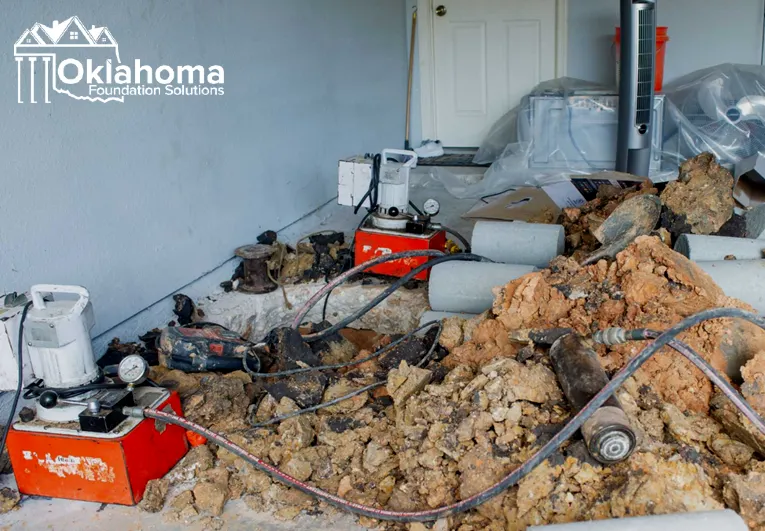
Traditional foundation repair methods can sometimes feel like a full-scale home invasion. They can turn your peaceful sanctuary into a noisy, dusty construction zone, and your once-tidy living spaces into a chaotic mess. Imagine the typical byproducts of these methods:
- Heavy Equipment Intrusion. Large machinery rumbling through your living spaces, potentially damaging your floors, walls, and doorways. Think about the stress of maneuvering bulky equipment through your carefully decorated home, with the constant risk of damage.
- Noise and Mess. The deafening roar of jackhammers or concrete saws tearing up your concrete slab, sending vibrations throughout your home. Dust and debris infiltrate every corner, coating your furniture and belongings.
- Floor Demolition. To access the damaged foundation, your beautiful hardwood floors, meticulously-laid tiles, or cozy carpets are ripped up and removed. The sense of home comfort turns into living in a construction zone.
This “old way” of foundation repair not only strains your budget with its high costs, but it also disrupts your life, damages your property, and leaves you feeling stressed and displaced. There’s a better way.
OFS provides polyurethane injections, an engineer-approved process. Polyurethane injection, also known as poly-leveling or foam injection, has been and continues to be a viable solution. It can be a truly optimal solution in some situations. The procedure lifts and stabilizes concrete slabs in a minimally invasive manner.
We will explore the many benefits of this process in Part Two of this blog series. For a free evaluation of your property to see if polyurethane injection is right for your home, contact us here or call 405-331-7171.